Showing posts with label Mainstream Christianity. Show all posts

Wednesday, February 2, 2011

Why I believe (Pt.3): Belief in "Christianity"


As you may remember from some time ago, I was trying to critically examine and explain my beliefs in other aspects of my faith such as my belief in God and my belief in the Bible. In this installment I (finally) want to talk about why I view those previously mentioned beliefs through the lens of Christianity (and by "Christianity" I mean in the most basic sense of belief in the life and teachings of Jesus, and not necessarily all the mainstream christian views)

First, it is inevitable to say that one of the reasons I believe in Christianity is because of my environment. I grew up in a Christian home that regularly attended services and sent me off to church camp every summer for a solid decade. On top of that I've spent countless years around Bibles, C.S. Lewis books and plenty of friends and conversations associated with the Christian faith. So while I've come to amend many of the beliefs instilled by said environment, I suspect Christianity is always going to affect my world-view in some form or another, like it or not.

My emotions also play a big part as to why Im a Christian. While there are things in the traditional mainstream faith that emotionally disturb me (like eternal punishment), a great deal of other things appeal to what seems to be ingrained in me as subconscious truth, if you will. For example, the idea that our salvation is not our work but God's work is very appealing. As well as the christian belief that Gods love for us is unconditional and everlasting (but more realized in the universalist's theology of course, which is part of why I embrace that as well).

The idea of the afterlife is perhaps another big one, because I just cant imagine a world where countless cruel things happen without something on the other side to balance it all out, and not let those who died in poverty or slavery or poor health be given the short end of fortune forever. There is many an injustice that goes unrighted in this world and I cant imagine there isnt something on the other side to make right what has gone wrong. If God exists and has a good plan for us, I would imagine no experience in this life is ultimately meaningless and therefore it is my hope that He will one day show usall the meaning we missed, as well as its value on the other side.

The last reason is simply my life experiences (which I guess ties in with emotions too, as they affect how I perceive said experiences). Not that I've had too cool of experiences, but I have seen a few "demons" being cast out of people in the name of Jesus. Ive also "spoke in tongues" on several occasions, at least the first time being something Im pretty sure was genuine. Those times were some of the most peaceful and divine moments in my life. When Im away from seeking God, I feel empty and like I need something more. So I try to seek him in the ways that have worked previously, because thats usually when I feel the most peace and direction in my life, and are most loving and guiding to those around me.

Perhaps you're thinking that I just believe a bunch of stuff because I want to, and it sounds sensible to me? And thats probably true to some extent, but I think everyone else does something similar whether they realize it or not. The reason being for that is when it comes down to it, we all need to organize abstract concepts like love, justice, and mercy in some way to give our lives meaning. Not that one has to be christian, let alone religious, in order to organize and interpret such things, but I personally find that a modified-Christian paradigm provides a good foundation for achieving just such an organization. And I feel a sense of truth radiating from many of its key ideas and perceptions.






Saturday, November 21, 2009

To preach, or not to preach?


So as many of you know by now, I'm beginning to believe that I am called to be a pastor, or something ministry related at least. There are a number of reasons that have been more or less "snow balling" within me, however I believe the conclusion was finally triggered a few days ago. And so Im going to attempt to walk through the process that brought me here, in hopes to clarify to myself (and to others) what I'm thinking on this...

The last several weeks/months have left me very frustrated with life, what with my car dying, my job giving me less and less hours, and my graphic design leads giving me less than stellar results. I had been feeling for a few months now that maybe I was supposed to do something that didnt strictly pertain to my graphic design degree, but I wasnt sure just what. That and I tried to avoid thinking about it, since I didnt want to be one of those American morons that spent years going to college for something, only to realize afterwards that they wanted to pursue something else entirely. But the doors of opportunity appear all but open in this crappy economy. So finally I prayed in desperation, asking God to tell me what I was supposed to do even if I didnt want to hear it, and the idea of a pastor and ministry immediately came to mind. Being as its something ive only passingly entertained in my mind before, I naturally asked God if He had gone completely mad or if I was just hearing things.

After mulling it over for awhile though it began to make more sense. Over the past several months I've heard time and time again, from both Christians and non-Christians, that I should be a pastor...though I'd always respond how I didn't feel cut out for that line of spiritual duty (and Im still wondering if I am). After all, who am I really? Just some artist/musician guy who writes religious blogs and works at a supermarket. I have a number of issues that cause me not to be the model Christian more often than not(ex. impatience, laziness, selfishness) , and I struggled with giving speeches in both high school and college. So I certainly wouldn't seem to be the most likely candidate for a preacher-type.

Though I guess when you think about it, Jesus chose some pretty unlikely people to first spread His word; A couple of them were fishermen, Matthew was a tax collector and the apostle Paul murdered Christians before Jesus appeared to Him. Prior to Jesus calling them, none of them probably had a clue as to the great roles they would play in God's story. And perhaps in a similar way, God has used other people to call me to something I never would have considered in years past.

Another thing thats helped spur me in this direction, is my over all frustration with "church" and Christianity in general. As ive stated before, its really been a struggle finding my place within a system that I no longer believe in. I love God, I love the scriptures, I love all my Christian brothers and sisters and I support many things that churches are doing throughout the world. However, going to church in the attempt to salvage what truth I can and plant seeds of knowledge, has been an endeavor that has left me more frustrated than uplifted. All you are given in church today, are traditional interpretations and ideas(with small variances here and there) in a manner that leaves little room for personal interpretation. And if you are so bold as to question the clergy's interpretation, you are often looked down upon and told how you cannot possibly be right. Which makes my biggest problem with Christianity not the fact that I disagree with it on a couple key beliefs, but that it has fooled itself into thinking its beliefs are beyond reconsideration.

As long as Christianity lives in that delusion, it will continue to discourage its participators from thinking and discerning for themselves. As long as people arent discerning for themselves, they will continue to commit the most tragic crime of religion: elevating man-made beliefs above God's conviction within us. And the more I realize this, the harder it is to simply sit by while good-intending leaders of faith, direct people down a path that can cripple their spiritual growth (as it did mine). Thats why, God willingly, I want to bring believers together in a setting where people arent guilt-tripped into believing a certain set of doctrines, but are free to have their own interpretations. A place where I can give a message according to what I feel God is showing me, but also let everyone voice their opinion. A place where I can tell people about Gods truly unconditional love and salvation for humanity, that I never learned about in "church". A place where I and others are truly unbound by fundamentalism, to search the scriptures ourselves and see what is true. Perhaps some meetings we wont even talk about the God, but simply go out into the community and reflect God in deed. And the only setting I can think of that this would be realistic would be in like in a home or some other non-formal location.

Im not sure whether God is really calling me to ministry or not, or just how exactly I am supposed to go about that. And my views on any of the above ideals could change or become more specific, especially in my ordination process (which is part of the reason I want to go through with it, to give me time to sort out my vision). But if He is calling me to minister, I hope I can help give people the tools to search out God themselves through the scriptures, and underpin it with the fact that God's spirit is the ultimate teacher...not a creed, not a church, not a theologian, and certainly not me.

So to preach, or not to preach? I dont know, but either way I'll still make annoying Facebook statuses ;)

Tuesday, September 15, 2009

Grace THROUGH faith

What is it that really saves us? My entire life I've been told that we are not saved by anything we do, but by what Jesus has done. The key verse that people back this up with is Ephesians 2:8-9,

For by grace you have been saved through faith. And this is not your own doing; it is the gift of God, not a result of works, so that no one may boast.

People use this verse to say that grace is not of ourselves, but yet seem to think that faith is of ourselves entirely. This is perhaps why many Christians "blame" non-believers themselves(rather than God) for not having faith before they died. But if faith is of ourselves entirely, and is not a gift of God, then wouldnt we have something to "boast" in as believers? If us mustering up the faith to believe, is what makes salvation applicable, then we are doing something to save ourselves; we are in effect, saved by a work of ourselves!

That seems to be against everything Paul is saying here though. He says,
for by grace you have been saved through faith. and this...
This what? This grace? No...this grace through faith. And so what about it? It is not of your own doing; it is the gift of God. Grace comes with faith, and vice versa...Paul doesnt seperate the two components to salvation and say that one is of ourselves, and the other is not. So perhaps faith is like the vehicle, by which grace comes to us FROM God to execute salvation within us.


Photobucket

some might object however and say,
Well you have to accept that gift

And I think thats true to an extent, but again if that ability to accept something is entirely of ourselves, it is us that is doing a "work" to be saved...not God and His grace. So I think God has to make someone able to accept grace through faith, if it is truly not of themselves. Simon Peter didnt believe that Jesus was the Son of God all on his own, he believed because God revealed it to him. In Matthew 16:15-17, Jesus says
"But who do you say that I am?"
Simon Peter replied, "You are the Christ, the Son of the living God."
And Jesus answered him, "Blessed are you, Simon Bar-Jonah! For flesh and blood has not revealed this to you, but my Father who is in heaven.

If you get nothing else out of this blog, get this: Grace is what enables us TO have faith!

I think this more or less blows a hole in the mainstream christian theology that says that faith is up to us and our "free" will. Because these verses seem to say that it is not up to us to save ourselves or give ourselves faith; it is of God and his dispensation of revelation to people individually. And if that is so, then it is logical to say that if someone dies without having received said grace through faith, that it is not they that are ultimately responsible...but God.

But wait, God cant be to blame for the sinner that rejects Him! you may reply.

Yes, God is totally responsible for our salvation, if it is truly not by our own works. That includes our acceptance and rejection of it. Paul testified to this too in a sense, in Romans 9:18,
So then he has mercy on whomever he wills, and he hardens whomever he wills

Did you catch that? He wills, not our wills. It is His will that some(probably most) will be hardened from the gospel this side of the grave.
But this is only disturbing though, if we think that Gods title as "Savior of All Men" will never truly be fulfilled. This is only disturbing, if we constantly beat every bible verse and thought against the doctrine of "free" will. We need to realize that God has a plan that wont fail.

The end result of those people that are hardened, will not be eternal separation(which according to what we've examined, would be Gods fault basically). They too will come to God, when He allows them to. Because it is true that no one can come to faith in God, unless God draw him (John 6:44). But it is also true that God will draw all men to himself (John 12:32). What time table God decides to do that under I will not limit him, but I will say that it is not limited merely to this short human existence we have been granted.


Tuesday, September 8, 2009

"If everyone goes to heaven, whats the point?"

*(the picture of Bush has nothing to do with anything...I just thought his confused look was hilarious)

This is a question that seems to turn up in every objection to universalism Ive seen thus far, so I thought maybe id blog about it finally

If Hell is not eternal, and everyone eventually gets to be with God...whats the point of doing good or following God? Shouldn't we just do what we want now, since it doesn't matter anyway?

I think people ask this question (as I did too once) because the idea of Ultimate Reconciliation really causes us to reassess the foundations of the Christian faith. And in this case, it reassess our motivation to serve God. That motivation, I think, is often clouded by our evangelical conception; that following God in this life yields the "treat" of heaven, while failing to do so yields the "spanking" of eternal hell. So when universalism takes out eternal hell and replaces it with age-long chastisement, I suppose one could justify that they dont need to serve God, since the punishments are only temporary anyway.

But if a husband continually cheats on his wife, and justifies it by saying,"well, she wont leave me forever, she'll love me no matter what", is it fair to say that that man probably doesnt really love his wife?
In the same way, if the sole reason we serve God is because we are terrified of the idea of eternal punishments, is it fair to say that we dont genuinely love God at all? In that case, we would only be serving God out of fear...fear of punishment or abandonment, not out of love or willful obedience. The same can be said if we serve God only because of the reward of an eternal paradise, except that its not out of fear that we would be serving God, but out of lust for the reward itself. Its kind of like a dog standing on his hind legs at command, simply because he knows his master will give him a doggie treat for it. The dog probably doesnt do it out of love for the master, but rather a love for the taste of bacon-flavored bites.


Photobucket>

Because of Jesus, all of the worlds offenses have been forgiven (1 john 2:2) and we are now under grace, not a system of rules in which we have to perform. But just because God loves us no matter what we do, doesn't mean we should just "party it up" and sin our lives away. I have never endorsed that view, nor do the scriptures appear to.
In fact, Paul talked about that very thing in Romans 6:15-17,
What then? Are we to sin because we are not under law but under grace? By no means![...]
But thanks be to God, that you who were once slaves of sin have become obedient from the heart to the standard of teaching to which you were committed.
Paul makes it a point to say that our obedience is from the heart, thusly I think that is the real underlining reason to serve God...because we want to do so, from the bottom of our hearts.

Another common question along the same lines is,
So whats the point in spreading the gospel, if everyone is just going to be saved anyway?

I think the first point to make here is that Jesus tells us to "go and make disciples of all the nations"(Matthew 28:19), so apparently God wants us to be apart of his truth-revealing process to the world. Secondly, but perhaps of equal importance, is the fact that it doesn't take a PhD to see that we live in a very broken world, in need of the knowledge that God loves them and died for their sins. All throughout the Gospels, Jesus's compassion for the lost was evident, Matthew 9:36-38 is a good example,
When he saw the multitudes, He was moved with compassion, because they were weary and scattered, like sheep having no shepard. Then He said, "The harvest is truly plentiful, but the laborers are few. Therefore pray the Lord to send out laborers into His harvest".

Christ made "the harvest" possible through His blood shed, so as followers of Him (of which His spirit lives inside) we should be laboring in His name, and in the same vein of compassion He had for people. We shouldn't let people suffer their whole lifes, and through whatever "hell" is, before having a joyful and fulfilling relationship with Jesus. God revealed His goodness and grace to us, so why wouldn't we want to share that with others so that they too can experience it? The notion of Hell not being eternal, and being for a good and remedial purpose...doesn't discredit our faith, or our reason to share it. If anything, it should allow us to truly lay our hopes in Him...that its not up to us to save people, or always live perfect lives. God loves us no matter what and has a good purpose for us from now, til forever.

That's good news I feel like sharing, how bout you?


Tuesday, September 1, 2009

Does orthodoxy always = truth?


Many times, people say that I am wrong in my beliefs because they dont strictly adhere to what Christian orthodoxy says(orthodoxy being the long established, and "approved" doctrines). And while I can respect such beliefs and their place in the church, I cant help but wonder why something should be deemed true, simply because it is orthodox or traditional?

After all, many things have been "traditional" or accepted throughout human history, that we now (generally speaking) deem evil or incorrect. Slavery is a good example of something that was accepted and practiced for hundreds of years, but now most would consider vile and disgusting(at least in our European countries). It was once traditional or orthodox to say that the earth was flat, even though we now know it not to be(though I guess thats not a perfect analogy, since thats something a little more observable and thus provable). But maybe on a more related note, many times in church history have we found things to be incorrect or untrue. The most famous of those being in the Reformation, when Martin Luther proposed that salvation comes to us via Gods grace, and not by paying clergy men or any other "work" we could do. If the so called "orthodox" opinion could be rightly challenged back then, why can it not be now? If traditional church opinions were prone to error even in its earliest of days, what makes it free from any error here in more modern times?

The consensus in Christianity seems to be that orthodoxy should be accepted on the merits that those who created it did so with "tried and true methods"(none of which, people seem to elaborate much on). But what began to disturb me about that, is that we are told to accept those orthodox traditions and ideas even when they appear to make the Bible seem contradictory.
If anything is "dangerous" I think it may be this line of thinking; that we cannot scrutinize the theories or interpretations of those who first proposed our core Christian doctrines. Almost as if our allegiance should be to the Church and its doctrines first, and then to God(if He falls in line with the established theology, of course).

But this seems ridiculous to me, first of all because our allegiance should first be to what we feel God is trying to show us personally. And secondly because the church has always had varying doctrines and positions on every conceivable matter since its birth. So just because a certain set of beliefs have been deemed "orthodox", it is only so because of a consensus at some point in history...not necessarily because it is an irrefutable fact. I like the way John Shelby Spong puts it,
"To be called Orthodox Christian does not mean that one's point of view is right. It only means that this point of view won out in the ancient debate."

With that said, our belief in what is true shouldn't be based upon a consensus or tradition, or even what any religious teacher says...but rather on the conviction that God gives us through the Christian scriptures and even just through everyday life. We dont have to have all of our theology spoon-fed to us, we have the ability to discern for ourselves, and I think that is what is meant by 1 John 2:27(WNT),
And as for you, the anointing which you received from Him remains within you, and there is no need for any one to teach you. But since His anointing gives you instruction in all things--and is true and is no falsehood--you are continuing in union with Him even as it has taught you to do

Even Jesus posed the question,
"And why do you not judge for yourselves what is right?" Luke 12:57
Jesus wasnt talking to the religious "orthodox" teachers of the day, he was talking to everyday people. So whatever is truly "right", Im not sure that it neccesarily needs to pass through the hands of teachers and orthodox doctrines, to be interpreted as such. We can "judge for ourselves"

This is not to say, that I or anyone, should place ourselves as "wiser" than orthodoxy and its established conclusions. There is alot of value to be had in tradition and its ideas, but that doesnt mean we should negate our own abilities to interpret and study the evidence, Biblical or extra-biblical. We should consider what others have to say on such matters, but the ultimate conclusion, I believe, should be left to the Holy Spirit within...not man and its varying and conflicting doctrines.

Sunday, July 12, 2009

Finite sins against an infinite God


In Christianity, you will often hear something like this,

our finite sins deserve infinite punishment, because they are against an infinite God

Though I have already talked a lot about God's Justice in a previous blog, this particular belief continues to boggle my mind. As humans, we can neither physically see, touch, or prove God and/or His truths...yet He supposedly thinks we deserve unending punishments for temporary mess ups? Why would a perfect God be even less understanding than a human?

Were we not born into sin by no fault of our own? If it is anyones fault, it is Adams...but even he was tempted by the Devil that GOD (yes, God) created. So from the very start, our "free" will has been at the mercy of forces and situations completely beyond our control. And all of these things have been allowed by God for some purpose(s), so how would it be sensable for God to hold us, imperfect beings by nature, forever accountable for the situations he placed us in? It makes no sense at all.

And it is curious indeed, that no scripture (that Ive ever come across) teaches such a bleak truth. No where is sin against God described as needing infinite punishment, solely just because God is infinite. The Bible simply describes the penality for sin as "death" (Ro. 6:23). And whether it is a physical or spiritual death described here(I would say both), it doesnt seem to imply the merit of infinite punishment we supposedly deserve.

On a final note, it is often said that Jesus paid the price for our sins, that he took our punishment for us. This goes along with the prophecy in Isaiah 53:5, which says,
But he was pierced for our transgressions, he was crushed for our iniquities;

Yet we also say that we all deserve an infinite period of suffering because of our sin. Using the same logic however, we would have to assume that Christ suffered infinitely in order to pay the infinite debt we incurred. But, as any Christian can tell you, Jesus rose again just 3 days after death...he did not experience infinite suffering for one persons sins against God, let alone the whole world's sin!

So there is apparently a big hole in our theology


Tuesday, July 7, 2009

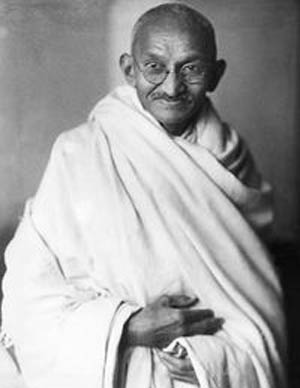
Identifying with Gandhi


I like your Christ, I do not like your Christians. Your Christians are so unlike your Christ.” -Mahatma Gandhi

This quote, at one time, greatly offended me. It seemed like a bash against Christians and made me think,
Even though Gandhi did alot of nice things, he sure is going to Hell!

But as time goes by, Ive come to greatly identify with the statement. And ive begun to understand why many people can find the person of Christ so compelling...while finding the religion that bears His name and His followers quite distasteful.

I suppose in one way Ive never quite felt like I "fit in" with the Christian community even from my early days of being a believer. Yet even long before I came into the belief of universalism, I've felt less and less like I can relate to other Christians. We (apparently) serve the same God, believe Jesus is the way of Salvation, hold to the Bible as truth...yet when I go to church or talk to other Christians I feel more frustrated and suffocated, than I do encouraged. I feel like were on two different wave lengths when in theory, were supposed to be on the same one.

As to any one reason why I feel like this, I suppose there isnt just one in particular. If I were to rattle off every reason why I'm not crazy about Christians in general, I'd be here all night writing this thing. But I will say its not really a "all Christians are hypocrites!" mentality that Im dealing with. There are many wonderful Christians I know trying to serve the Lord and really do love Him and other people. I dont doubt the good intentions of many Christians I know (whether I agree with their methods or not).

I think what it really comes down to though, is the fact that Jesus, and the beauty of Gods love, stretches so far beyond the concrete walls of church, our religious rituals and our padded Christian subculture. I've come to a point where none of that is very appealing or edifying to me...because God and His love are not confined to that system. That system of rules and organization has been too often equated with having a passion for God. For example, if you dont go to church regularly, or involve yourself with church activities, or listen to Christian music, or hold the same beliefs as other Christians...you're love of God comes into question. Ive become disillusioned with the system of Christianity we have made for ourselves, and that has caused some people to be concerned about me. Nevermind the fact that now I feel freer and more able to love and seek God, I dont believe and do the same things other Christians do! So that seems to put me on some sort of mental prayer list.

Its so backwards to me...Christians seem to be more concerned with people subscribing to their brand of faith than they are with people seeking God. They wouldnt say that, but that is what Ive seen, especially now that my beliefs dont identify with the typical religious crowd.

But when I remind myself that Jesus himself never identified with the typical religious crowd, I realize that Im probably on the right track. All throughout the gospels it seems that Jesus is pitted AGAINST the religious people and their laws. Jesus would acknowledge scripture and their laws, but he would always show how a love for God and for others far out rooted the rules and rituals of religion. Jesus was a dangerous adversary to the rich religious crowd and to their power...which ultimately got him plotted against and killed. And that is probably why Gandhi liked Christ and not so much the Christians. He saw in the character of Christ a loving person that was beyond religion and was willing to love and show people truth regardless of their sins or social status. Yet when Gandhi saw the Christians, he saw people overly concerned with everything BUT loving people more often than not.

With all that said, I think its time for me to put more time and energy in seeking and loving God, and helping me express his undying love for others.... rather than pleasing other Christians by subscribing to their doctrines and practices.

Tuesday, May 12, 2009

The nest of tradition


In the eight month period of what I've decided to call my "spiritual renaissance", I feel God has really challenged me to step outside my head so to speak. To break the Christian box. To stop confining Him to all these preconceived notions, particularly the ones people instilled in me as irrefutable truth(with good intent of course). To stop assuming that I have things all figured out.

And this was very uncomfortable to me, as I think it is for any human. Bishop Carlton Pearson says,
"the human mind has an incredible capacity for refusing to see what it doesnt want to see. Sometimes we feel that we know so much, that we dont want to know anymore. That we dont want to consider that there just may be another aspect of truth we havent considered yet."( very loosely quoted).

Thats where I was, and in some ways still am. I had prayed many months ago to be closer to God, to have that passion that I had in years past again. All I wanted was God back the way I knew Him...I didnt particularly want new or enhanced understandings. So there I sat in my ship with all the questions I (to this day) believe God allowed me to have for good reason.
I prayed constantly and cried out to God...I just wanted to love others and help them see God like I had in years past... but He finally helped me realize that in order to do that, I needed to stop trying to sail back to what I knew before, and completely release myself from the shores of mainstream Christianity and let the good Lord guide my ship.

So finally I did, and I let myself examine the concepts that I had completely either written off as crazy or were only slightly sympathetic to (such as ultimate reconciliation). And slowly but surely I felt the anger and confusion melt away in awe of an amazing, transcendent God. I felt challenged, but also willing to examine my old beliefs and adjust them according to what God was showing me...even when it didnt seem to make sense...or in the case of ultimate reconciliation...too MUCH sense (haha).

At the same time I developed a knack for skepticism, to the extent that I never really had before. Ive never been a fan of questioning things too much or too deeply (until these last 8 months or so) but it unwillingly became ingrained as apart of my thought process.
At the same time I get the typical sense of surety that I shouldn't question such things...that I should just accept what Ive been taught growing up. But what am I afraid of? If God is truth, more investigation of that truth will only confirm it and give me a more solid ground to stand upon. Truth would not and will not magically overcome God and the Bible if they indeed be true, in which I believe they are. So I began to question why I KNEW what I did, how was I so sure?

I knew that I had had reasons to believe what I did, but was there a bigger picture of the world that I wasnt seeing?

Even though I feel like the dust has settled and I feel my beliefs more solid than they were previously, I constantly ask myself this. And I feel that question ultimately has led me to a much grander view of truth. Coming back into having a passion to debate and investigate I cant help but ask myself "Who is really right? Could I be wrong?". I wish more Christians were able to do that. because one of the main problems I see in the world today is the fact that everybody thinks they're right about everything, and so little do we challenge that. We're so ready to accept whats been handed down to us, and what the preacher says on Sunday mornings, that in the process we may plug our ears and laugh at a more reasonable (and often times, more Biblical) view.

Our tradition and Christian religion is a wonderful incubator or "nest" in which a fledgling Christian can hop around and chirp. A place where one can open their little mouth in hunger and eat the worm of mainstream doctrine, and be safe from the likes of atheist and Muslim birds. But eventually the fledgling grows up and gets sick of the prescribed doctrine worms. Eventually the bird is tired of his sibling birds who have grown enormous egos along with their bodies. The small nest no longer suits his need for growth and shelter. And thus the once little bird must spread his wings and fly into the unknown, and make his own nest so to speak. I call this flying "the nest of tradition" or phase two of the Christian life. Its not to say that one disregards everything one learns in the nest, but that our growth in God and understanding Him cannot be contained to the nest of tradition and its interpretations.
Flying outside of that nest I feel I have more of a real love for God and people, and a bigger view of Him and His ways.

So many times we seem to value our tradition more than we value what the Bible says or what God may be trying to show us. In Matthew 15 some Pharisees get mad at Jesus because His diciples didnt wash their hands before eating, as was the tradition. And Jesus replies in verse 3-7,

"And why do you break the command of God for the sake of your tradition? ...(buncha stuff)... you nullify the word of God for the sake of your tradition. 7You hypocrites!..."

I think Jesus implies here that our tradition, The Bible, and what God shows us arent by nature in the same camp...and should be separated when they come into conflict with one another. Failure to do so gets us stuck in our man-made religions and ideals...instead of a pursuit for God. I think we should no longer allow such tradition to get in the way of the things Gods trying to show us...and in doing so will make us so much wiser as I feel I have started to become.

Its possible and am almost sure that I am still wrong about some things. That other people may be wiser in some respects, even some fundamentalist Christians. I certainly hope Im right about many things, most particularly ultimate reconciliation and Gods unfailing love for all humanity. But at the end of the day I've come to conclude that THIS is where God wants me to be. This is the place of mind where He has led me and where He broke the oppression from my heart. My understanding always has and always will be in need of growth (as is the case with everyone). And I could spend all day everyday in torment worrying that God will be forever furious if I dont get the perfect definitions of everything. But God purposefully has not given us the answers to everything in "clear as day, proven fact" form. So the only thing we can do as human beings, is to piece together the evidence given in the most coherent matter possible, with the Holy Spirit guiding us accordingly. And thats what I try to do now as I live life...nothing more, nothing less. I dont think God honestly expects anything more of His creations, how could He? And that is part of why I believe He truly has an unfailing and unconditional love for us all, that death itself cannot and will not stop.

So wont you fly the nest? Isnt it so cramped and confusing in there? Isnt it so frustrating dealing with the "know it alls" after awhile? Arent you ready to let the spirit of God take you on a journey to see a bigger view of the world and His love for it?I admit it can be scary at first, but I think its healthy to really look at why we believe what we do. To not stubbornly presume we have the "right" interpretation and everyone else is just wrong and deceived by Satan. To truly examine the possibilities. I think in doing that we can begin to understand people and God so much better.