Showing posts with label rethinking christianity. Show all posts

Sunday, May 22, 2011

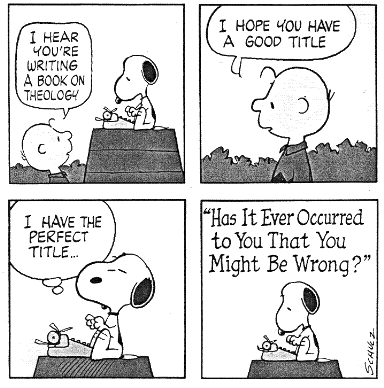
Can one be a Christian and still think?


The more I analyze my personal beliefs and in what ways I still identify with the Christian religion, the more lost I tend to feel. It seems the more I learn and the more I critically examine the ideas I once held as facts, I honestly just don't know what to believe sometimes? Two years ago I would have said that I agree with mainstream Christianity on most things besides concepts like everlasting punishment for unbelievers, but now its hard to say I agree with it on much of anything at all. And I think this dilemma has only come to amplify itself over the past year and a half since I felt a call to ministry. After all, if I cant concretely make up my mind about what I actually believe and what direction I should go, how on Earth can I teach others what to believe and what direction they themselves should go?

This is to be expected though, since within the last few months its finally dawned on me just how much you're never taught in church. I mean, if going to church is any way supposed to be a Christian education for the average believer, I think its safe to say it has failed miserably. You're never taught, for example, what the actual differences between the gospels are or that many scholars are unsure if any of the apostles even wrote them (in other words, every saying and deed attributed to Jesus should be taken with a grain of salt). You're never taught much, if anything, about alternative views on Hell and salvation such as Christian universalism. You're never taught that the Bible is in fact not without error and has quite a bit of internal disharmony theologically speaking. You're never taught about alternative eschatologies such as pantelism and preterism which date Christ's symbolic return within the lifetimes of the apostles as opposed to 1,978 years into the future and counting. You're never taught that there is little to no historical mention of Jesus outside the New Testament. And you're rarely even taught that one can be a Christian without completely disregarding the scientific consensus of the Earth being billions of years old, rather than a few thousand years old. So if Christianity were compared to an iceberg, I think its fair to say you're only shown the very tip of it in church, while the rest is kept submerged beneath like some deep dark secret that its ashamed of. Or perhaps a crazy old uncle that has a room in the basement that no one really talks to or about.

Honestly, why is that?

My guess is that these types of things aren't taught because if they were it would undermine the faith of a good many people. More specifically it would undermine people's faith in several popular church doctrines. But if the truth really does set us free, as Jesus supposedly said, what could really be the harm in at least giving such things some mention? Should we not be seekers of truth first, and Christians second? What importance is any religion if it is either at odds with or turns a blind eye to the facts? I'm aware of the inherent uncertainty that comes about when some of this lesser known information is brought to light, but regardless of what we make of it the facts still remain. People deserve to know of these things even if it doesn't change their faith or their approach to it in any way. And this is one of the reasons I'm thankful for individuals like Rob Bell who are bold enough to put some of the lesser known viewpoints like universalism and post-mortem salvation out on the Christian table for all to see. We need more leaders in Christianity who are willing to do those sorts of things no matter how controversial they may be.

Anyway, to the point of all this rambling: I often wonder if one can (or at least if I can) be a Christian and still think with honesty and sincerity? Most Christians I'm sure would respond positively to that and of course there have obviously been many Christians who have also been very deep thinkers such as C.S. Lewis. But what I've come to find is that it's often times hard for me to be true to my faith while also being true to my conscience. Faith can be a great tool to fill in what we humans cannot yet fully grasp about our purpose and our existence, but it can also act as a pair of blinders when it comes to things outside of what we've been taught to believe. For instance, it doesn't matter how heartfelt and sincere a Muslim or someone of another faith may come across, they're still in conscious rebellion to God because they do not see Jesus like we do. God has revealed the "truth" to them as obviously as He has to us Christians but they just choose to do all this other stuff that they don't really believe in. Or it doesn't matter how many conflicting passages and ideas seem to be in the Bible, or that it was written in an ancient time and culture far removed from our own. It is still the perfect Word of God and to say anything else is to call God a liar. Or so mainstream Christianity often teaches.

I guess to my mind, there is just little to no reason to believe some of the things that many Christians do. Some beliefs (like eternal torment) I honestly don't want to believe anyway, but then there are other things (like the accuracy of the gospels) that I really wish I could believe but just cant for the most part. I believe in God as the creator of our universe, I believe in Jesus as a savior from sin and from more primitive views of God. And I believe the Bible contains some wise insights and musings about God and His relationship to us. Yet beyond that I just have mountains of questions and doubts, most of which I have really no idea how to process. Even on the more liberal side of Christianity, I find people super confident in things I can only find to be a bit entertaining to think about (like with basically all eschatology), yet beyond that I just have to kind of shrug my shoulders. And most of which I'm coming to conclude doesn't matter too much in the grand scheme of things, since I don't believe in a God who's future acceptance of us depends on which religious avenue we died on. But they are important questions none the less and I will need to figure out some way to approach them if I am to take this pastor thing seriously.

So can one be a Christian and still think? Well, I sure hope so.

Sunday, April 10, 2011

The Problem with Theology

*Capitan’s log, star date: I don’t really give a a flying borg’s eye…*

If you were to take two people with two differing theologies , put them in a discussion on a differing belief and you stripped down what they were saying, it might go something a little like this,

“No, you’re wrong. You’re wrong because this verse says so” Said Person One.


“Actually, I’m right because that verse doesn’t mean what you say it does, it means something else” replied person two.


Person one looks puzzled and shouts “What? No, that verse can’t possibly mean that! It has to mean this because this other verse says this, and that confirms what I’ve been saying all along!”

*rinse…repeat…sometimes for hours*

I’m sure we’ve all heard or read or been in a conversation like this before. And it is always interesting how one theology interprets everything to fit in a certain “grid”, so that when someone else suggests one of those pieces should change its position, the first theology shouts about how that can’t be so because it doesn’t fit properly in their “grid”. But seldom some wonder whether or not part of their grid (or perhaps the whole thing) may be incorrect. And this is to be expected, since such a question is quite daunting and uncomfortable, but what happens is this: What could be a potential learning process becomes more of a war of the doctrines. It is a war in which no one ever really wins (just YouTube a controversial video dealing with religion, and you will see what I’m talking about). Hence, to some degree I’ve lost interest in the topic, or at least debating it with any vigor or desire to show others that I’m right.

You think I'm wrong? Well, cool...but I just dont really care. I'm more than willing to hear you out on why you think I'm mistaken, but at the end of the day, who really knows who's right? I mean, in all genuine honesty, how? The problem with everyone is that they think they've arrived at the highest form of truth (or at least somewhere in the ballpark of it), when there's absolutely no way to prove what the highest form of truth is. In fact, not only is it something you cannot prove, but your opposition probably thinks they have the highest form of truth as well.

Everybody’s enlightened…everybody’s saved…and everybody is lucky enough to be the chosen ones. Or so everybody thinks, at least.

I mean once upon a time I loved theology. In some way I still do love it, but not so much in the sense of trying to pin point every right belief about God and the Bible. This, I would say, is mostly because no matter how much you study (the Bible, the Christianities, etc), all the conclusions you come to are merely assumptions. That’s it…assumptions. Assumptions based on other assumptions. Some of those assumptions might be more historical or traditional than others, but they are usually based in no more objective evidence than the next assumption. And then we feel inclined to take those assumptions and spend loads of time trying to beat the differing assumptions out of someone else. It's all rather pointless, and usually not that loving either.

This is also why I waste absolutely no time in calling people “heretics” or “false teachers” just because they disagree with what I think is true. I mean, between the velvet lies, there may be a truth that’s hard as steel, but that doesn’t make it any more obvious in a world where God seemingly made it impossible to prove such things, does it? Do I really need to call you a name or judge your character or relationship with God, just because you believe differently than me? And do you really have to brand me as “out of your club”, just because my ideas didn’t get the highest votes among some old stuffy men in Rome, over a thousand years ago? I think it’s just better to accept our differences, and share ideas when and where civility isn’t going to be an issue.

So what do we do? How do we determine the “right” theology? Is that even possible? No, I don’t really think so. Yet, I think one can get an ‘A’ for effort, if they are at least trying to determine what is most true about God and spiritual realities. All we can do is make the best assumptions that we possibly can. After all, we don’t have any other choice but to abandon the search all together and be content with an existence only in-tune to the physical and provable dimension (which some do). Yet some of us still have a hunch that there is still some very real truths to be uncovered (even if only partially) within this spiritual quest we find ourselves in.
So, we must push forward and continue to test the fruits and test the spirits, as I mentioned in my last blog.

Sunday, April 3, 2011

A Rebirth of faith

Since I sometimes get a kick out of reading my past religious musings, I decided to read a couple of my old blog entries the other day and happened to notice that while I had written thirty-three entries in 2009, I only had six entries for 2010. And so my question to myself was naturally, why did I write so little last year in comparison to the year before? Was it a lack of time or lack of ideas? Or was it the fact that my blog entries dont typically spur the conversations that my facebook posts tend to? Did I just have more to say as a new universalist/heretic in 2009 than in 2010 and beyond?

Truthfully, probably each of those things contributed a bit Im sure, but maybe the main reason is that the more I question every bit of my past understandings of God and faith, the less neat and definable my personal theology becomes. And its a little frustrating, honestly. I often find myself wishing I could return to the days of simplistic faith, when I didnt over-analyze everything I believed and why; when I just assumed the preachers could understand God and the Bible better than me. Yet in another sense I am glad that I am free of that dogmatic and legalistic system. My nervousness does not outweigh my feelings of liberation; a liberation that encourages me to finally go through with this ordination process and help others seek out God in Christ even beyond the orthodox understandings.

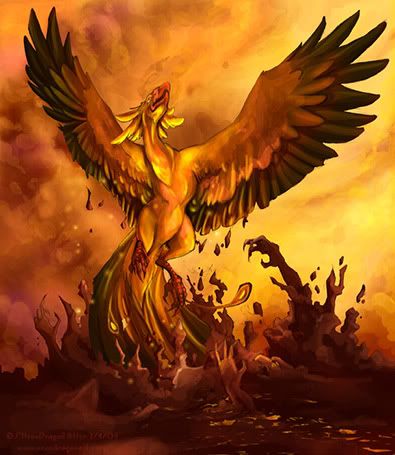
None the less though, I feel confronted with a belief-structure that is on its deathbed. And when a lot of religious people come to this point, the majority seem to find ways to just let go of spirituality all together (even if its over the course of several years). However I feel to do so would "throw the baby out with the bathwater" as the old saying goes. This is because I still find value in the spiritual symbols I've come to know and love, as well as my Christian tradition and its scriptures. Yet I've come to find that the more I examine not just individual doctrines, but the entire paradigm ive constructed is in desperate need of a refreshed and updated approach. Like the legend of the mythical Phoenix bird, no matter how magnificent it may have seemed at one time it eventually gets old, tired, and in need of that final rest. But as the story goes, the sun would shine down upon the bird bursting its remains into flames (or...something) and from its ashes a new fledging Phoenix would arise. And I am hoping and searching for God to do much the same thing to my faith (which I dont think is a stretch, giving the whole "born again" concept is a fairly big staple concept in Christian tradition).

So what might this reborn faith or approach to faith look like? To be honest, beyond a few vague ideas, I dont really know. I definitely dont think it means giving up on either God, Jesus, the Bible or even certain Christian rituals. What I think it does mean however, is attempting to look at all those things in a different (and often times, more reasonable) light, only returning to traditional ideas when and if they actually seem to work in a consistent spiritual paradigm. Its the kind of faith that isnt interested in being different from traditional Christianity merely for the sake of being different, but at the same time doesnt hold to it and its answers unquestionably so. It would be aware that it can be deceived and wrong at times, yet it is not afraid to use the heart and mind that God himself gave us. It is a faith that loves and cherishes the Bible (and even possibly other holy books or books period) but is aware that realistically no one writer or person can speak for God, even if he/she has a message inspired by their God experience or Gods spirit. This faith would be free from the delusion that any one religion or spiritual perspective can fully contain, define and confine the vast and mysterious entity we call God. And this faith realizes that for every statement or hypothesis about God and truth that we can make, it will most likely only be a shadow or outline of the actual reality. In a nutshell (or bird eggshell), this faith is simply interested in discovering and experiencing the God and His/Her/Its truth, whatever and wherever that is.

Is this kind of faith possible without drifting off into extreme spiritual vagueness and uncertainty? I honestly dont know. I suppose the best one can do is to try to "test the spirits"(1 John 4:1) and determine if what we believe or are coming to believe is worthy of the God we have come to experience, which is not an answer that will be the same for everyone. We should also look at each of our beliefs much like Jesus suggests we should look at people (Matthew 7:15-20), and determine from the "fruit" produced which is good and which is not. If said fruit causes us to be violent, angry, sad or in any way abusive to others and the world/opportunities given to us, then it may indeed be bad fruit. However, if it causes us to show love, use our resources wisely, discover peace and connect us with the God experience, it is likely to be a good fruit. And while this approach doesnt necessarily determine which beliefs about God and truth are indeed true, it may at least give us a guiding star by which to determine what may be MORE true about God and what may be MORE true about ourselves and others.